Understand how LEGO Ideas combines fan submissions, support thresholds, expert review, rights and launch proof in one governed demand funnel.
Short answer: answer: LEGO Ideas lets fans submit product concepts, requires them to earn community support and sends qualifying ideas through a professional review before any product decision. Rights terms, creator compensation, production standards and launch collaboration sit around that path. The system works because 10,000 supporters opens a review; it does not guarantee a set.
The popular summary—fans vote and LEGO makes the winner—removes the most important part of the model. A support threshold is evidence of organized interest, not proof that a safe, stable, licensed, profitable and portfolio-appropriate product can be manufactured.
The opposite simplification is that community voting is merely promotion. It also filters submissions, reveals narratives that mobilize fans and creates a visible constituency before expert product work begins.
The Submission-to-Shelf Governance Funnel
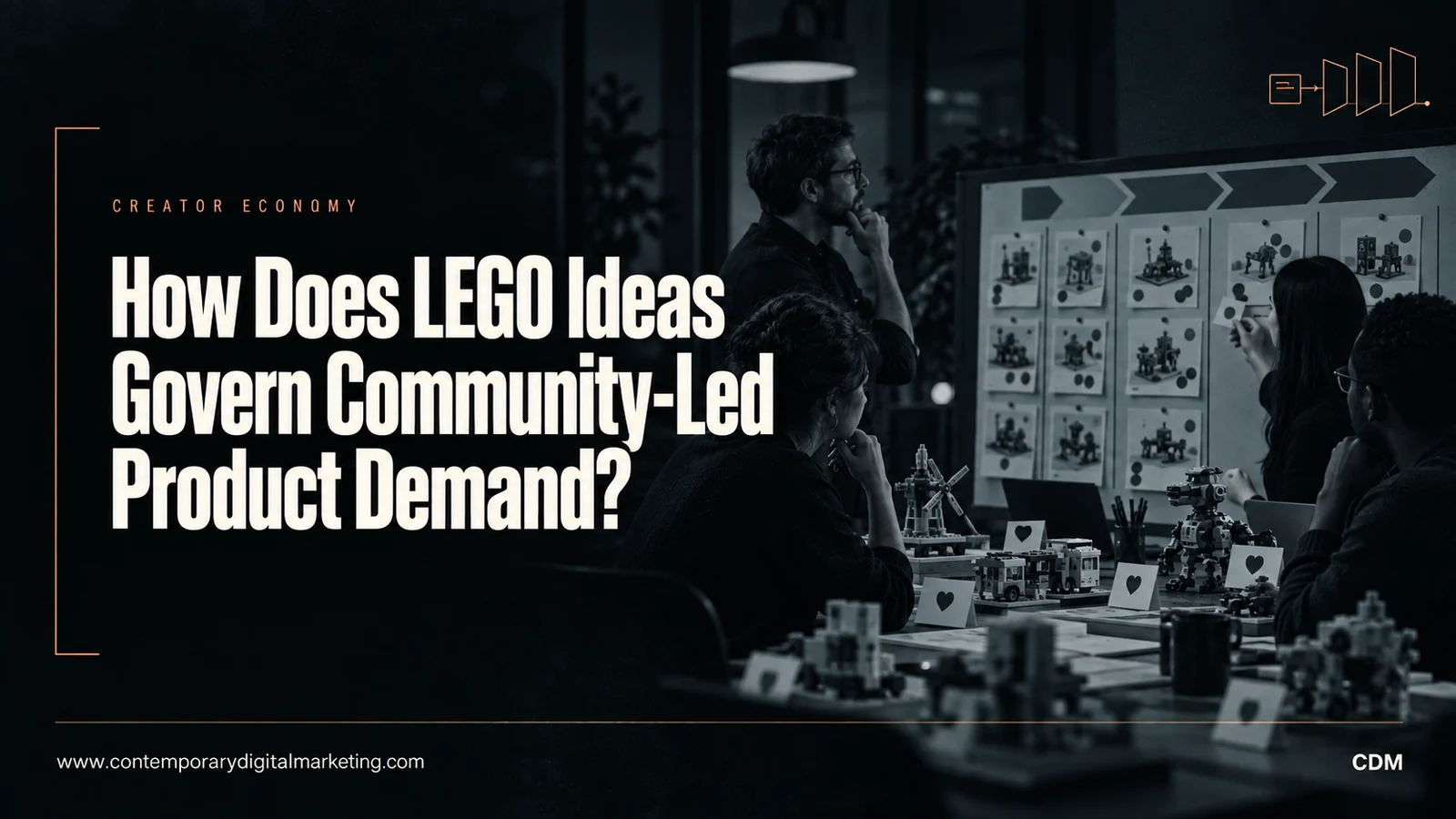
CDM calls the system the Submission-to-Shelf Governance Funnel. Its six gates are Eligibility, Submission, Support, Review, Development and Launch. Rights and communication operate across every gate.
Our position is clear: community demand is useful only when the company retains explicit professional gates and tells participants that support earns consideration, not production. Removing that distinction makes popularity compete with safety, feasibility and portfolio judgment.
Gate 1: Eligibility limits what enters the system
LEGO Ideas is a defined open-innovation program, not a general inbox for every business suggestion. The LEGO Group describes it as a community where fans can submit set ideas, vote, join challenges and engage in activities. A separate innovation intake process has existed for ideas that are not specific LEGO models.
Current terms set account and age conditions and govern submissions, voting and interaction. This boundary helps the company apply the right review logic and helps participants understand what the program can actually do.
A transferable program should publish a narrow problem space, prohibited material, technical constraints, required proof and participant eligibility. Broad calls such as “send us your ideas” create volume while transferring classification work and disappointment to the operator.
Gate 2: Submission turns enthusiasm into an assessable object
A fan presents a build or concept in a structured public environment. The submission must communicate what the product is, why it belongs and how it works well enough for people to support it and for reviewers to assess it.
The artifact also begins a rights relationship. Current LEGO Ideas policies state that submissions may assign rights to LEGO System A/S while the idea remains under consideration, with reversion in specified circumstances, and they restrict some commercial uses by submitters. If LEGO commercializes a product idea, compensation follows the rules in force when the project reaches the required supporter milestone.
Those terms are material and can change. A participant needs the current binding rules, not a blog summary. Any company running a similar program should use plain-language guidance beside the legal text and require contributors to confirm third-party rights.
Gate 3: Support measures mobilized demand, not total demand
The main Product Idea experience uses community votes, and LEGO states that an idea reaching 10,000 supporters has a chance to enter the product portfolio. Current policy material also describes staged time limits and supporter milestones on the journey to 10,000.
A support count shows that a creator can attract verified platform members under the program’s rules. It may indicate concept appeal and community energy. It does not reveal price sensitivity, retail demand, production cost, geographic breadth or the number of supporters who would buy the finished set.
Measure the composition and velocity of support where privacy permits. A fast burst from one fan community tells a different story from sustained interest across markets. Neither should be mistaken for a sales forecast.
Gate 4: Expert review protects the product system
LEGO’s official comments on qualifying projects explain that a review board can include designers, product managers, marketing representatives and other specialists. Factors may include current and developing products, brand fit, expected demand, licensing, capacity, stability, safety, feasibility and playability. The review board makes final decisions.
This gate is the heart of the model. Community proof and professional judgment answer different questions. Fans reveal support for a concept. Experts determine whether a responsible product can be made and whether it fits the portfolio.
A company should publish review dimensions without pretending every decision can be reduced to a score. Licensing negotiations, strategy and confidential pipeline conflicts may require discretion. The promise should be a fair process and clear outcome, not automatic selection.
Gate 5: Development changes the submitted idea
Selected ideas move into professional product development. LEGO’s public descriptions emphasize collaboration with LEGO master designers. A fan concept must be translated into a product that meets manufacturing, instruction, safety, stability, packaging, legal and commercial requirements.
The final product will therefore not be a factory copy of the submitted model. This should be stated before entry. Define who owns final decisions, how the creator is consulted, which changes require consent and how credit is handled.
Development is also where an organization tests whether it can fulfill the community promise. A crowdsourcing program that selects more ideas than it can support turns demand proof into a backlog of broken expectations.
Gate 6: Launch closes the proof loop
Official LEGO Ideas releases name the fan origin and often include the designer in the story. LEGO states that creators whose concepts become products can share in profits, subject to applicable rules. The shelf product, creator credit and launch narrative demonstrate that participation can produce a real outcome.
Launch is not only the reward at the end. It replenishes belief in the funnel. Future contributors can see selected cases, while unsuccessful projects reveal that support and selection are different gates.
Measure launch demand separately from supporter demand. Compare forecasts, sell-through, returns, creator participation and community response. Preserve non-selection reasons at a useful category level so the next cohort learns without exposing confidential product plans.
Evidence ledger, chronology and mechanism map
| Public evidence | Status | What it supports | Boundary |
|---|---|---|---|
| 10,000 supporters can qualify an idea for consideration | Documented by LEGO | A visible community threshold | It is not a production guarantee |
| Review considers brand, demand, licensing, safety, capacity and feasibility | Documented in official project comments | Multi-disciplinary professional gating | Weighting and confidential conflicts are not public |
| LEGO Ideas began through CUUSOO and became a global program | Documented history | The model evolved over years | Historical rules may not be current rules |
| Selected fan ideas are developed with LEGO designers and share in profits | Documented by LEGO | Creator recognition and economic participation | Exact terms depend on applicable rules |
| Gates convert interest into governed demand | CDM inference | Fits the observed process | The causal sales effect is not isolated |
The mechanism map is fan creativity → structured submission → community mobilization → threshold signal → expert portfolio review → professional development → creator-attributed launch → renewed community participation. Each arrow has a rule, owner and possible rejection path.
The Community Product Funnel Canvas
Use this concrete asset before opening submissions:
| Gate | Pass evidence | Owner | Rejection or correction path |
|---|---|---|---|
| Eligibility | Participant and idea meet published scope | Community operations | Redirect or explain scope |
| Submission | Complete artifact and rights confirmation | Moderation/legal | Request correction or reject |
| Support | Verified threshold within stated period | Platform operations | Expire, extend only by rule, or archive |
| Review | Demand, brand, legal, safety, capacity and economics assessed | Cross-functional board | Publish outcome category |
| Development | Product brief, creator role and feasibility approved | Product lead | Pause, redesign or cancel with communication |
| Launch | Supply, attribution, compensation and campaign ready | Commercial lead | Reschedule with documented reason |
Add service levels for moderation, review and creator communication. Do not announce a public threshold until the organization has capacity to review every idea that can reach it.
A small-team version
A smaller brand should not imitate LEGO’s scale. Run a cohort with one theme, no more than 20 approved submissions and one published selection window. Use a lightweight expression-of-interest first, then request full materials from finalists. Offer a non-production reward for strong ideas that do not pass feasibility.
Set support as one input, not the decision. Require a cross-functional review covering customer need, brand fit, rights, unit economics, safety and operational capacity. Publish the timetable and communicate at every gate. The smallest credible program is one the team can finish.
Related guides
Frequently asked questions
Does reaching 10,000 supporters guarantee a LEGO Ideas set?
No. LEGO states that 10,000 supporters gives a product idea a chance to be considered and moves it into professional review. The review board assesses factors such as brand fit, expected demand, licensing, product overlap, production capacity, build quality, safety, feasibility and playability.
Many supported ideas can therefore be declined for reasons that a public vote cannot resolve. The threshold is a qualification signal, not a purchase order. Current rules and timelines should always be checked on the official LEGO Ideas site because the program can change. A company copying the model should state this distinction beside the support counter.
Are LEGO Ideas votes the same as purchase commitments?
No. A support action indicates interest under platform rules but does not necessarily include a price, deposit, shipping market or obligation to buy. Supporters may like the concept while rejecting the final design or price. Some may be mobilized by the creator’s existing audience.
Treat votes as one demand signal and validate willingness to purchase through research, forecasting, retail evidence or crowdfunding where the model permits. The caveat is that support still has operational value: it shows that a concept can organize attention and gives reviewers evidence unavailable from an internal idea alone.
Who owns a fan-submitted product idea?
The answer depends on the current program terms and the submission’s status. LEGO Ideas policies describe rights assigned to LEGO System A/S while submissions are under consideration, reversion in specified circumstances and compensation if a product idea is commercialized. Third-party intellectual property and collaborations add complexity.
Participants should read the binding current terms rather than rely on summaries, and seek advice when the stakes justify it. A new community program must state ownership, license scope, exclusivity, reversion, creator use, credit and compensation plainly. Ambiguity at submission becomes conflict after success.
Why does LEGO still need expert review after community voting?
Because voters cannot evaluate every condition required to manufacture and sell a safe product. Designers and product managers assess build quality and portfolio fit; legal and licensing specialists assess rights; operations assess parts and capacity; commercial teams assess demand and economics. The vote answers whether a visible group supports the concept.
Review answers whether the company can responsibly turn it into a product. Combining the two is the strength of the funnel. The caveat is that expert discretion needs accountability: published review dimensions, consistent process and timely communication help prevent “expert judgment” from becoming an unexplained black box.
Should a small brand use public voting for product ideas?
Only if it can moderate the process, verify support, manage rights and complete the promised review. Public voting can expose customer enthusiasm and create participation, but it can also favor creators with larger audiences, invite manipulation and create expectations that popularity wins.
Use voting as one input and reserve explicit expert gates for feasibility, economics, safety and brand fit. A private customer panel or paid prototype test may be better for sensitive or technical products. Start with one bounded cohort and fewer than 20 approved entries so the team can communicate well and finish what it starts.
What should happen to ideas that are not selected?
Give creators a timely outcome, a useful reason category and clear information about rights after closure. Avoid implying that every declined idea was weak; portfolio overlap, licensing or capacity can defeat a strong concept. Archive the public record when appropriate and explain whether the creator can reuse or commercialize the idea under the terms.
Offer learning, recognition or a pathway to a future theme where feasible, but do not create false hope. A transparent correction and appeal route is appropriate for eligibility or moderation errors; product judgment itself may remain final. Non-selection is a designed stage, not an exception.
Next decision: How Does GoPro License and Reuse Customer Content at Scale?
Related reading: How to Turn a Creator Community Into a Durable Brand Growth Asset · Brand Safety Versus Creator Independence: Negotiating the Real Trade-Offs · Creator Content Rights in the AI Era: Licensing, Attribution and Reuse
Sources and research notes
- LEGO Group: Fan engagement and programs and What is LEGO Ideas? — official descriptions of the community, 10,000-supporter threshold and consideration boundary. Checked 26 September 2026.
- LEGO Ideas policies — current platform, access, rights, commercialization and compensation terms. Checked 26 September 2026; binding terms should be rechecked before publication.
- LEGO Ideas official review comment example — official explanation of review factors and final decision authority. Checked 26 September 2026.
- LEGO Group history: LEGO Ideas and 10 years of crowdsourcing — primary program chronology and historical scale. Checked 26 September 2026.
- Limitations: rules, milestones and compensation can change. Public materials do not disclose selection probabilities by category, supporter-to-buyer conversion or the incremental commercial effect of the program. The funnel and small-team design are CDM analysis and recommendations.
This article is editorial guidance. Apply the principles in proportion to your market, evidence, and responsibilities.