See how Sephora responsibly links member identity, community participation, shoppable content and rewards, with a practical triangle for retail teams.
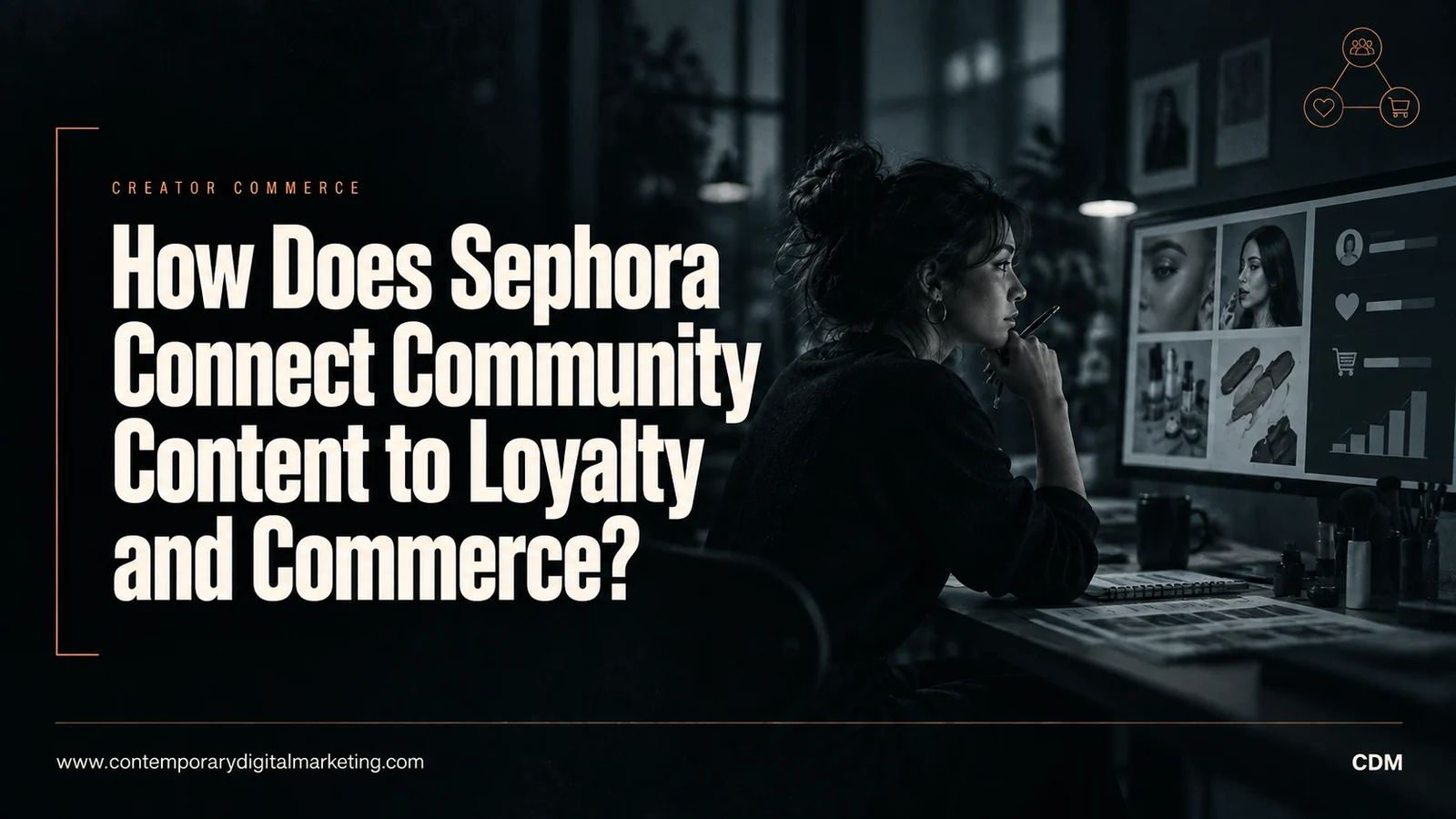
Short answer: answer: Sephora connects a Beauty Insider member identity with product reviews, photos, forums, groups and questions, while the loyalty program records purchases and rewards and selected social content can link to products. The operating model is a Community-Loyalty-Commerce Triangle: community reduces uncertainty, loyalty creates continuity and commerce turns useful guidance into action. The public record supports that architecture, but it does not disclose the incremental sales caused by community participation.
Retail community programs are often judged by posts and comments. That misses their commercial job. In beauty, the shopper needs help with shade, skin type, routine, application and expected results. Useful peer content can answer questions that product specifications cannot.
The opposite error is to force every conversation into a sale. If recommendations feel manipulated or critical experiences disappear, the community loses the trust that made it commercially useful.
The Community-Loyalty-Commerce Triangle
CDM’s Community-Loyalty-Commerce Triangle has three sides and one center. Community creates context. Loyalty preserves identity and a reason to return. Commerce makes products findable and purchasable. Trust sits in the center; weaken it and all three sides underperform.
Our position is specific: community content should be optimized first for decision quality, not immediate conversion. Commerce compounds when members can give credible help, preserve their identity and move to a product without losing context. A feed filled with purchase links but weak peer value is merchandising, not community.
Side 1: community turns product uncertainty into usable context
Sephora’s Beauty Insider terms reveal the breadth of the member contribution layer. Closing an account removes access to the Community account and the ability to post product reviews, upload photos, participate in forums or groups, and answer product questions. The Community site also organizes discussions into topic groups.
These formats address different decisions. Reviews aggregate experience around a product. Photos show results and use. Questions resolve specific uncertainty. Forums and groups support broader routines, identities and relationships.
Structure matters. Attach product-specific content to stable product entities while keeping general conversation in topical spaces. Require disclosed incentives, label sampling and preserve negative but policy-compliant experience. Moderation should target abuse, fraud and irrelevance rather than inconvenient opinions.
Side 2: loyalty gives participation continuity
Sephora says Beauty Insider is a free rewards program in the United States and Canada. Current terms describe one point per eligible dollar for the main tiers, tier qualification, a member profile and a Rewards Bazaar. The company’s About Us page dates the loyalty launch to 2007.
The loyalty identity connects transactions, benefits and community access under an account. That continuity can make the next interaction more relevant and lets a member return to a recognizable relationship rather than an anonymous product page.
This does not mean points should be paid for positive commentary. Rewarding sentiment corrupts the evidence shoppers rely on. If participation earns status or benefits, reward quality-neutral actions such as a verified review meeting disclosure rules, helpful moderation or an answered question—not praise or purchase claims.
Privacy boundaries are essential. A member may accept purchase tracking for points without expecting purchases, forum identity and sensitive beauty concerns to be combined for targeting. State which data crosses each side of the triangle and provide controls.
Side 3: commerce preserves the context that earned the click
Sephora’s Instagram content terms provide a concrete example. They grant Sephora specified rights to use approved Instagram content in a Beauty Insider Community Gallery and to let users “shop your look” by appending product images and links to ecommerce surfaces.
The important design is not the link alone. The customer sees a look or result, then can identify the relevant products without manually reconstructing the routine. Content becomes a decision surface.
For a transferable system, every commerce handoff should preserve the creator or member context: products used, variant or shade, application order, disclosure, date, availability and material caveats. Do not append products merely because they are commercially preferred. If the tagged item differs from the one used, say so.
The center: trust is an operating property
Trust comes from visible rules, identity signals, moderation, disclosure and the ability to encounter mixed evidence. Verified purchase can be useful, but it should not silence legitimate non-purchase experience such as samples or services. Creator content can inspire, but sponsorship and rights should be clear.
Moderation needs a decision record for removals, edits, conflicts and appeals. Commerce teams should not control review policy alone. Community, legal, product, customer care and merchandising need defined roles.
The brand must also protect participants when photos reveal faces, homes, health conditions or minors. Reuse in a gallery or advertisement is a new context. Obtain permission for that use and make the takedown path findable.
Evidence ledger and observable chronology
| Public evidence | Status | What it establishes | Boundary |
|---|---|---|---|
| Sephora launched Beauty Insider in 2007 | Documented by Sephora | A long-running loyalty foundation | Does not measure community contribution |
| One member account connects points, benefits and Community access | Documented in current terms | Identity spans loyalty and participation | Internal data flows are not fully public |
| Members can review, upload photos, use forums/groups and answer questions | Documented in account-closure terms | Multiple community formats exist | Activity and helpfulness levels are not disclosed |
| Approved Instagram content can appear in a shoppable Gallery | Documented terms | Content-to-product linking is designed | Incremental conversion is not disclosed |
| Community reduces purchase uncertainty | CDM inference | Fits the format and beauty decision | Requires local behavioral testing |
The observable chronology is loyalty foundation → digital member profile → connected Community capabilities → shoppable customer-content uses and broader omnichannel earning or redemption. Public sources establish the architecture at selected dates, not a complete internal product history.
The Triangle Journey Audit
Use this concrete asset on ten high-consideration product pages:
| Test | Pass condition |
|---|---|
| Community relevance | Content answers a real pre-purchase or usage question |
| Evidence diversity | Positive, negative and conditional experiences remain visible |
| Identity clarity | Member, verified purchase and incentive labels are understandable |
| Product mapping | Exact product, variant and date are connected to the content |
| Context preservation | The product page retains the question or look that led there |
| Loyalty purpose | Login provides a genuine benefit without blocking basic evidence |
| Rights | Reuse channel, term and permission are recorded |
| Privacy | Sensitive participation is not exposed or unexpectedly targeted |
| Moderation | Rules, report flow and appeal owner are active |
| Measurement | Helpful interaction, product action and repeat behavior are distinct |
Require eight of ten passes before scaling a format, with no failure on rights, privacy or disclosure. Eight is a CDM threshold, not a Sephora benchmark.
A bounded implementation test
Choose one category where fit questions drive returns or support contacts. Recruit a disclosed group of customers with different needs and allow ordinary members to contribute. Create structured fields for context such as skin type, shade or use case, but make sensitive fields optional. Link content to exact variants and record any gifted product.
Measure helpful votes, question resolution, product-detail revisits, add-to-basket, returns, support contacts and 60-day repeat engagement. Compare journeys that use community evidence with similar journeys that do not, while acknowledging self-selection. Read a sample of negative and removed content. The goal is a better decision, which may sometimes mean the customer does not buy.
Related guides
Frequently asked questions
Is Sephora’s Beauty Insider Community the same as its loyalty program?
No, but the public terms show that they are connected through the member account. Beauty Insider governs points, tiers, benefits and rewards, while Community capabilities include product reviews, photos, forums, groups and questions. Closing a Beauty Insider account removes Community access, which demonstrates account-level connection.
That does not mean every community action earns points or that all community data is used for loyalty targeting. Product behavior and regional availability can change. When designing a similar system, document each capability separately and make any data sharing, reward or personalization relationship explicit rather than assuming one membership consent covers every purpose.
How can community content increase ecommerce sales?
It can reduce uncertainty, show products in realistic contexts and make the relevant item easier to identify and purchase. Sephora’s published Instagram terms describe a gallery use that can append product images and ecommerce links so people can shop a look. The causal sales effect is not publicly disclosed.
A retailer should measure question resolution, product-detail use, basket actions, returns and repeat behavior while accounting for self-selection. Some helpful content will correctly discourage a purchase, which can improve trust and reduce returns even if immediate conversion falls. Judge the system on decision quality and customer value, not only last-click revenue.
Should loyalty points be awarded for reviews?
Only under a carefully neutral policy that rewards eligible participation, never positive sentiment, and clearly discloses the incentive. Paying for praise makes reviews less trustworthy and can create regulatory risk. A better design verifies that the reviewer used or purchased the product where possible, allows critical views, screens fraud and separates helpfulness from positivity.
If points are offered, publish the amount, eligibility, frequency limits and moderation rules beside the review form. The exception is research or sampling programs with different objectives; those still require conspicuous disclosure and should not be blended invisibly into ordinary customer reviews.
What makes a beauty community commercially useful?
Useful context is the core: who used the product, for what concern, in which variant, with what routine and with what limitations. Searchable questions, structured product links, photos and topical groups can make that context retrievable. Commercial value follows when the shopper can move from evidence to the exact product without losing those details.
Strong moderation, incentive disclosure and negative evidence protect trust. A large comment count alone is weak. Categories with visible or experience-dependent outcomes may benefit most; commodity products with little uncertainty may not justify the same community investment.
How should a retailer measure community influence without overclaiming attribution?
Use a layered view: exposure to helpful content, interaction, question resolution, product action, conversion, return rate and repeat engagement. Compare matched journeys or phased changes where possible and disclose self-selection because people who seek community help may already differ. Add qualitative review of whether content changed the decision.
Last-click credit to a product link understates earlier learning, while view-through credit can overstate it. For strategic decisions, test specific features such as structured context or answer speed rather than asking whether “community” caused all revenue. Preserve an unknown category where the evidence cannot identify influence.
What rights are needed to make customer photos shoppable?
Obtain permission covering the display, product tagging, editing, territory, term, channels and any paid or partner use, along with necessary rights from people and third parties shown. Sephora’s published Instagram terms describe a worldwide, perpetual right for specified gallery and ecommerce uses, but another brand should not copy that language without legal review and a proportional rights decision.
Preserve the accepted terms with the asset and provide a clear contact or takedown path. A social post’s public availability is not permission for commercial reuse, and product tags should not imply endorsement beyond what the contributor agreed.
Next decision: How Did Notion Turn Templates and Ambassadors Into Product Adoption?
Related reading: Creator Storefronts and Curated Collections: Building a Persistent Sales Channel · From Creator Sale to Customer Relationship: Connecting Campaigns to CRM and Retention · Responsible Personalisation: Creating Relevance Without Crossing Into Manipulation
Sources and research notes
- Sephora: Beauty Insider terms and conditions — official membership, points, rewards, profile and connected-partner terms. Checked 26 September 2026.
- Sephora: Beauty Insider terms, February 2025 version — official account-closure language listing reviews, photos, forums/groups and Q&A capabilities. Checked 26 September 2026.
- Sephora Community: Instagram content terms — official terms for gallery display and “shop your look” product linking. Checked 26 September 2026.
- Sephora: About Us — official 2007 loyalty-program chronology. Checked 26 September 2026.
- LVMH 2023 Universal Registration Document — parent-company account of Sephora’s loyalty, community and omnichannel strengths; used only as company reporting. Checked 26 September 2026.
- Limitations: Sephora does not publicly disclose community-attributed conversion, retention, return-rate or incremental revenue in the reviewed sources. Interfaces and terms vary by market and time. The triangle, threshold and pilot are CDM analysis and recommendations.
This article is editorial guidance. Apply the principles in proportion to your market, evidence, and responsibilities.